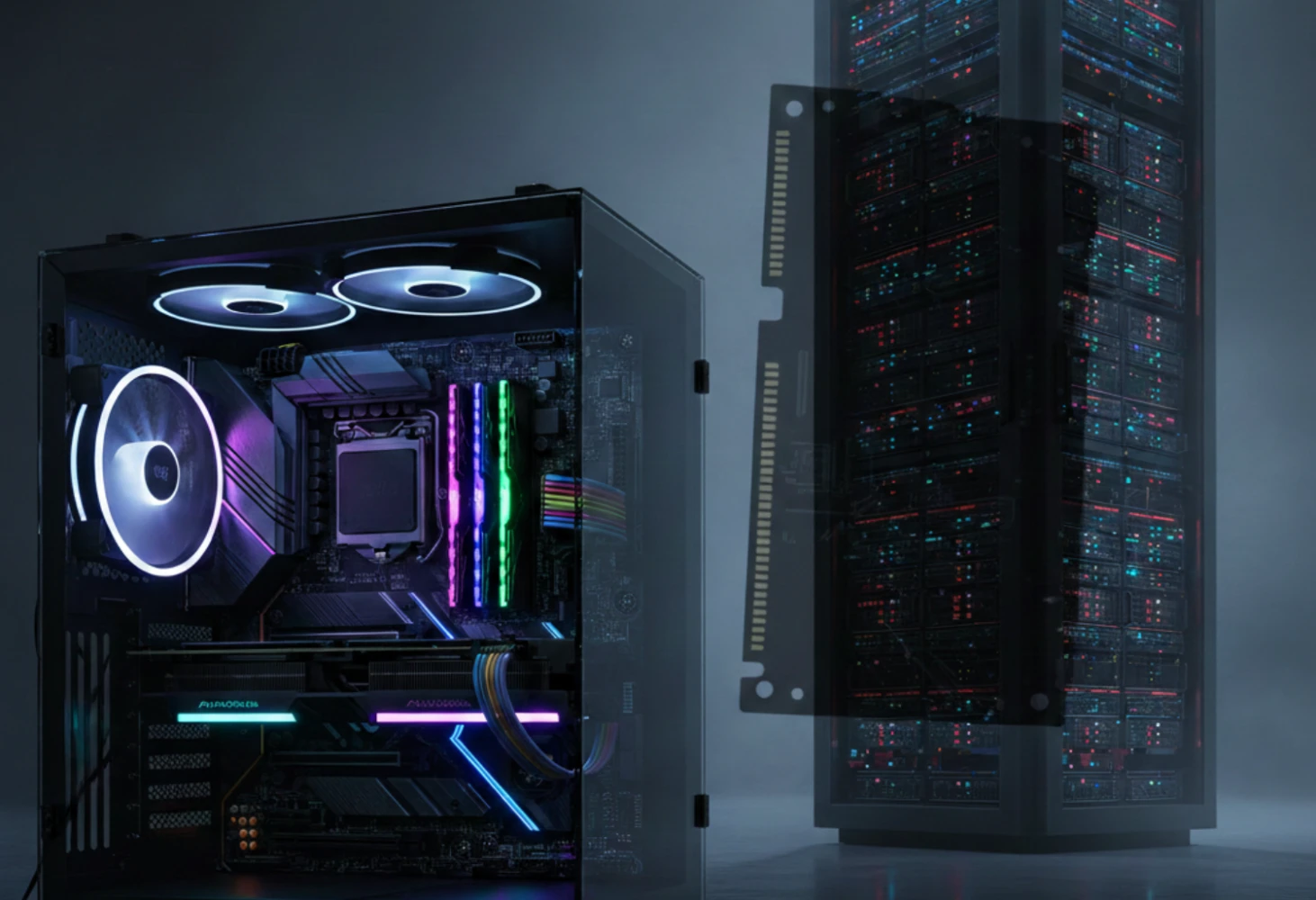
If you’ve tried to upgrade your PC lately, you’ve probably noticed something unsettling. That 32GB RAM kit you were eyeing six months ago has somehow become significantly more expensive. Your mate down at the computer shop is complaining about it. The forums are full of people wondering when prices will drop. The answer, unfortunately, might be “not anytime soon.” Welcome to the RAM-pocalypse, where artificial intelligence’s insatiable appetite for memory is reaching into your wallet and making itself comfortable.
The AI Data Centre Explosion
The scale of what’s happening in the AI infrastructure world is genuinely staggering. Companies like Microsoft, Google, Amazon, and Meta are engaged in what can only be described as an arms race to build the largest, most powerful AI training facilities on the planet. We’re talking about data centres that consume more electricity than small cities and require cooling systems that would make industrial refrigeration plants look modest.
These AI workloads demand memory in ways that traditional servers never did. A typical web server might happily run with 64GB or 128GB of RAM. An AI training cluster? Try terabytes. Each individual GPU in these systems needs to be fed with massive amounts of high-bandwidth memory to keep the processors running at full capacity. When you’re training large language models or processing image recognition at scale, the bottleneck usually isn’t the processors themselves, it’s getting data in and out of them fast enough.
The projections for growth make your head spin a bit. Industry analysts reckon data centre capacity dedicated to AI workloads will triple between 2024 and 2026. That’s not a gradual increase, that’s an explosion. Every major tech company is announcing multi-billion dollar investments in AI infrastructure, and all of them need the same thing: more memory, faster memory, and lots of it.
The Memory Supply Crunch
Here’s where things get interesting, and not in a good way for us consumers. The global memory market is dominated by three main players: Samsung, SK Hynix, and Micron. Between them, they control roughly 95% of the DRAM market. That’s quite the oligopoly when you think about it.
Building new memory fabrication plants takes years, not months. We’re talking about 18 to 24 months minimum for expansion projects, and that’s if everything goes smoothly. These aren’t facilities you can throw together quickly. They require clean rooms that make operating theatres look filthy, equipment that costs hundreds of millions of dollars, and expertise that’s concentrated in a handful of locations worldwide.
The manufacturers have been caught somewhat flat-footed by the AI boom. They planned their capacity expansions based on traditional growth curves, steady increases in demand from PCs, smartphones, and conventional data centres. Nobody quite anticipated that AI would create this level of demand this quickly. Even with announced expansions coming online in 2025 and 2026, there’s a real question about whether supply will catch up with demand anytime soon.
How Data Centres Outbid Consumer Markets
When it comes to who gets the available memory supply, data centres have some significant advantages over the rest of us. They’re buying in bulk, often commiting to multi-year contracts worth hundreds of millions of dollars. That kind of guaranteed revenue is incredibly attractive to manufacturers who remember the painful boom-bust cycles of the past.
The price premiums that data centre operators can pay are frankly astronomical compared to consumer pricing. When you’re building a facility that costs billions of pounds, paying an extra 50% for memory barely registers as a line item. For someone building a gaming PC, that same 50% increase is the difference between staying within budget and having to make painful compromises elsewhere.
There’s also been a fundamental shift in what memory manufacturers are prioritising. High-bandwidth memory (HBM), the specialised stuff that AI accelerators and GPUs need, uses the same fabrication capacity as standard DDR4 and DDR5 modules. Except HBM sells for several times the price per gigabyte. If you’re running a memory fab and you can choose between making consumer RAM or high-margin HBM for AI applications, the choice is pretty obvious from a business perspective.
Production runs of standard memory modules have been scaled back as manufacturers redirect capacity towards these more lucrative markets. It’s basic economics, but it doesn’t make it any less frustrating when you’re trying to build or upgrade a PC on a reasonable budget.
Impact on Consumer Pricing
The numbers tell a pretty grim story. A 32GB DDR5 kit that would have cost you around £90 in early 2024 is now pushing £140 or more, depending on the brand and specifications. That’s more than a 50% increase in less than a year. DDR4, which many people hoped would get cheaper as the market transitioned to DDR5, has actually held steady or even increased slightly because manufacturers are producing less of it.
The ripple effects go beyond individual components. Pre-built systems and laptops have seen corresponding price increases. Manufacturers can’t absorb those kinds of cost jumps on major components, so they pass them along to consumers. What was a £800 laptop is now £900 or more, even with everything else being equal.
There are some regional variations in how severe the pricing pressure has been. Markets with strong local currency against the dollar have fared somewhat better, whilst regions that import everything have been hit particularly hard. The UK, sitting somewhere in between, has seen prices climb steadily without quite reaching the eye-watering levels of some other markets.
Looking Ahead
So when does this get better? The honest answer is that nobody knows for certain, but there are some reasons for cautious optimism mixed with plenty of reasons to temper expectations.
New fabrication capacity is coming online. Samsung has expansions planned in South Korea, Micron is building in the United States with government subsidies, and SK Hynix is investing heavily as well. The problem is timing. Most of these facilities won’t be at full production until late 2025 or 2026. That’s still quite a wait if you’re planning a build this spring.
There’s also the question of whether AI demand will level off. Right now, it seems like every company wants to build or expand AI infrastructure. That kind of growth isn’t sustainable forever, economic realities will eventually assert themselves. When they do, we might see some relief in pricing. But betting on when that happens feels more like speculation than analysis.
Alternative memory technologies are in development, things like MRAM and ReRAM that could potentially shake up the market. The catch is that these technologies have been “just around the corner” for years now. Even if they reach commercial viability soon, it takes time for ecosystems to develop around new technologies.
For consumers navigating the current market, the advice is somewhat frustrating: if you absolutely need to upgrade, you’re probably going to pay more than you’d like. If you can wait, there’s a reasonable chance prices will improve in 12 to 18 months as new capacity comes online. But there are no guarentees, and “wait and see” isn’t terribly satisfying advice when your current system is struggling.
Where We Stand
The RAM market has become collateral damage in the AI infrastructure buildout. Data centres are outbidding consumer markets because they can afford to, and manufacturers are following the money because that’s what businesses do. It’s hard to blame any individual actor in this situation, they’re all responding rationally to market incentives. But the end result is that PC builders and upgraders are paying significantly more for components that were already expensive enough.
The broader implications extend beyond memory. As AI continues to reshape technology markets, we’re likely to see similar dynamics play out with other components. GPU prices, which have their own complicated history, remain elevated partly because of AI demand. Storage, networking equipment, even power supplies rated for high-wattage systems are all feeling the pressure.
The long-term outlook for memory markets depends largely on how quickly supply can scale to meet this new level of demand. History suggests that memory markets eventually find equilibrium, but the path there is rarely smooth or quick. In the meantime, those of us who remember the days of cheap RAM upgrades will have to adjust our expectations. The RAM-pocalypse might not be permanent, but it’s definitely going to be with us for a while yet.